Wildcat of the Streets: Detroit in the Age of Community Policing

Dr. Michael Stauch explains how newly elected Detroit Mayor Coleman Young introduced “community policing” to the city in 1974, an experimental approach to law and order that included affirmative action hiring policies and neighborhood police stations to address community concerns about both police brutality and criminal activity in the neighborhoods. Despite these changes, tensions with the police remained, leading Black youth in the city to embrace labor radicalism from the shopfloors as they built informal economies and decentralized gangs to challenge and achieve political and social power in the 1970s and 1980s. Stauch is an Associate Professor of History at the University of Toledo and author of Wildcat of the Streets: Detroit in the Age of Community Policing .

Related Resources:
Wildcat of the Streets: Detroit in the Age of Community Policing

Related Collections:
James and Grace Lee Boggs Papers (UP001342)
Kenneth V. and Sheila M. Cockrel Papers (UP001379)
Coleman Young Papers (UP000449)

Episode Credits
Interviewee: Michael Stauch
Producers: Dan Golodner and Troy Eller English
Music: Bart Bealmear

The Containment: Detroit, the Supreme Court, and the Battle for Racial Justice in the North

Professor Michelle Adams describes the struggles to integrate Detroit’s highly segregated neighborhoods and schools in the 1960s, a federal judge’s ruling to alleviate that segregation by bussing students between the predominately Black schools in Detroit and predominantly white schools in the suburbs, and the Supreme Court’s subsequent 1974 Milliken v. Bradley decision that acknowledged the segregated state of Detroit schools but overturned the “metropolitan remedy,” thereby allowing de facto school segregation to persist today.

Adams is the Henry M. Butzel Professor of Law at the University of Michigan and author of The Containment: Detroit, the Supreme Court, and the Battle for Racial Justice in the North.

Related Resources:
The Containment: Detroit, the Supreme Court, and the Battle for Racial Justice in the North

Related Collections:
Robert E. DeMascio Papers (LP002075)
Detroit Board of Education Detroit Public Schools Records (WSR000681)
Detroit Public Schools Community Relations Division Records (LR000951)
Damon J. Keith Papers (UP001582)
NAACP Detroit Branch Records (UR000244)
Remus Robinson Papers (UP000447)
Wayne State University College of Education, Dean’s Office: Detroit Public Schools Monitoring Commission on Desegregation Records (WSR001371)
Coleman Young Papers (UP000449)

Episode Credits
Interviewee: Michelle Adams
Producers: Dan Golodner and Troy Eller English
Music: Bart Bealmear

Remembering the Detroit Feminist Women’s Health Center

Dr. Beth Widmaier Capo discusses the Detroit Feminist Women’s Health Center and the role health practitioners there—including her mother—played in empowering women to understand their bodies and take control of their health in the 1970s. Capo is the Edward Capps Professor of Humanities and Professor of English at Illinois College, and author of the article, “The Detroit Feminist Women’s Health Center; Or, on Hearing Your Mom Described as ‘The Fucking Bravest Bitch I Knew.’”

Related Resources:
“The Detroit Feminist Women’s Health Center; Or, on Hearing Your Mom Described as ‘The Fucking Bravest Bitch I Knew.’”

Related Collections:
Detroit Feminist Women’s Health Center

Episode Credits
Interviewee: Beth Widmaier Capo
Producers: Dan Golodner and Troy Eller English
Music: Bart Bealmear

Coach of Champions: D.L. Holmes and the Making of Detroit’s Track Stars

Dr. Keith Wunderlich shares the life and legacy of D.L. Holmes, athletic director of what is now Wayne State University from 1917 though 1958. With a meager budget and outdated equipment, Coach Holmes nurtured a generation of track and field Olympians and world record holders in Detroit, regardless of race, ethnicity, or religious background. Wunderlich is co-author of Coach of Champions: D.L. Holmes and the Making of Detroit’s Track Stars.

Related Resources:
Coach of Champions: D.L. Holmes and the Making of Detroit’s Track Stars

Related Collections:
Wayne State University Collegian Newspapers (WSR001897)
Wayne State University Yearbooks (WSR002149)

Episode Credits
Interviewee: Keith Wunderlich
Producers: Dan Golodner and Troy Eller English
Music: Bart Bealmear

Seeking “Self-Determination” in Detroit: Housing, Race, and the Activism of the West Central Organization, 1964-1971

Dr. Anna E. Lindner discusses the rise and subsequent downfall of the West Central Organization in Detroit, a coalition of civil rights organizations, community groups, and church congregations that sought to bring attention to housing inequality and other social issues in the 1960s. Although founded with good intent, the group’s aggressive lobbying gained short-term results but turned local media and government administrations against them, and the predominantly white liberal leaders in the organization’s first early years struggled to fully understand and address the systemic racism faced by Black Detroiters.

Lindner is an assistant professor of Media & Communication at Nazareth University and author of the essay, “Seeking ‘Self-Determination’ in Detroit: Housing, Race, and the Activism of the West Central Organization, 1964-1971.”

Related Resources:
“Seeking ‘Self-Determination’ in Detroit: Housing, Race, and the Activism of the West Central Organization, 1964-1971”

Related Collections:
(WSR001897) Wayne State University Collegian Newspapers
(WSR001896) Wayne State University South End Newspaper
(LP000255)
David Cohen Papers

(UP000379) Jerome P. Cavanagh Papers

Episode Credits
Interviewee: Anna Lindner
Producers: Dan Golodner and Troy Eller English
Music: Bart Bealmear

Schools and the Rise of Mass Incarceration in a Post-Brown World

Dr. Matt Kautz explores how evolving school disciplinary practices, changes in crime reporting, and political pressure in the decades following school desegregation led to the rise of student suspensions, expulsions, dropouts, and the school-to-prison pipeline in Detroit and other cities. Kautz is an Assistant Professor in the Department of Leadership and Counseling at Eastern Michigan University. His article “Schools and the Rise of Mass Incarceration in a Post-Brown World,” was published in the Summer 2024 issue of Harvard Educational Review.

Related Resources:
“Schools and the Rise of Mass Incarceration in a Post-Brown World”

Related Collections:
(UR000267) Detroit Commission on Community Relations (DCCR) / Human Rights Department Records
(WSR000681) Detroit Board of Education Detroit Public Schools Records
Wayne State University College of Education, Dean’s Office: Detroit Public Schools Monitoring Commission on Desegregation Records

Episode Credits
Interviewee: Matt Kautz
Producers: Dan Golodner and Troy Eller English
Music: Bart Bealmear

When Detroit Played the Numbers: Gambling’s History and Cultural Impact on the Motor City

Dr. Felicia George explains how number lotteries in the city’s Black Bottom and Paradise Valley neighborhoods in the 20th century, although illegal and rife with exploitation, also raised some Black Detroiters out of poverty and created an important social support in a community stressed by racial discrimination and job insecurity.

Dr. George is an adjunct professor of anthropology at Wayne State University and the author of When Detroit Played the Numbers: Gambling’s History and Cultural Impact on the Motor City.

Related Resources:
When Detroit Played the Numbers: Gambling’s History and Cultural Impact on the Motor City

Related Collections:
Folklore Archive: Student Field Projects Records (WSR002714)
Folklore Archive: Student Field Projects Oral Histories (WSOH002714)
Folklore Archive: Studies and Research Projects Records (WSR001731)
Untold Tales, Unsung Heroes Oral Histories (UOH001605)
Wayne State University Libraries Digital Collections

Episode Credits
Interviewee: Felicia George
Producers: Dan Golodner and Troy Eller English
Music: Bart Bealmear

Hillbilly Highway: Charting White Migration from Appalachia to the Industrial Midwest

Dr. Max Fraser shares the often overlooked story of the “hillbilly highway,” the route nearly eight million poor, rural, white Americans took in the 20th century from economically depressed areas in the Southeastern and Southern United States toward higher paying factory jobs in the Upper South and Midwest. He explains how the social advancement and marginalization they experienced transformed American culture, the labor movement, and today’s political landscape.

Dr. Fraser is an assistant professor of History at the University of Miami. His book Hillbilly Highway: The Transappalachian Migration and the Making of a White Working Class received an Honorable Mention for the Frederick Jackson Turner Award from the Organization of American Historians.

Related Resources:
Hillbilly Highway: The Transappalachian Migration and the Making of a White Working Class

Related Collections:
Detroit Commission on Community Relations (DCCR) / Human Rights Department Records (UR000267)
George Roberts Papers (LP000038)
Lewis B. Larkin Papers (WSP000122)
Michael Manning Papers (LP000018)
UAW Local 78 Records (LR000645)
UAW Local 174 Records (LR000006)
UAW Oral Histories (LOH002229)
UAW President’s Office: Homer Martin Records (LR000063)
UAW President’s Office: Walter P. Reuther Records (LR000261)
UAW Secretary Treasurer’s Office: George Addes Records (LR000052_Addes)

Episode Credits
Producers: Dan Golodner and Troy Eller English
Interviewee: Max Fraser
Music: Bart Bealmear

Toxic Debt: An Environmental Justice History of Detroit

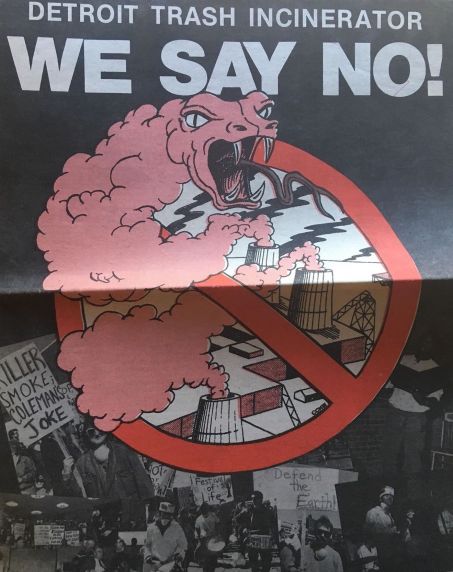
A poster on the back of an anti-incinerator publication proclaims: "Detroit Incinerator: We Say No!" From the Thomas Stephens Papers, Walter P. Reuther Library, Wayne State University

Dr. Josiah Rector explains that since the 1880s a confluence of unregulated industrial capitalism and racist practices in housing and employment in Detroit created pollution and environmental disasters disproportionately affecting the poor, working class, and particularly African Americans. He explores the resulting environmental justice movements in Detroit as residents have fought for clean air, water, and improved public health amid government and corporate divestment and Detroit’s 2013 bankruptcy. Rector is an assistant professor of urban, environmental, and labor history at the University of Houston and author of Toxic Debt: An Environmental Justice History of Detroit.

Related Resources
Toxic Debt: An Environmental Justice History of Detroit

Related Collections:
Joe Brown Papers
Olga Madar Papers
Thomas W. Stephens Papers
UAW Conservation and Recreation Department Records
UAW Foundry and Forge Departments Records
UAW Health and Safety Records
UAW President’s Office: Douglas Fraser Records
UAW President’s Office: Walter P. Reuther Records
UAW President’s Office: Leonard Woodcock Records

Episode Credits
Producers: Dan Golodner and Troy Eller English
Interviewee: Josiah Rector
Music: Bart Bealmear

Heard It On the News: Preserving 20th Century Detroit History Through Local Newscasts

Reuther Library audiovisual archivist Mary Wallace discusses the Library’s WWJ / WDIV Film, Video, and Teleprompter Scripts collection, which captures seven decades of news, current events, politics, and community life as reported by the Detroit news station from the 1920s through 1990s.

Related Collections:

WWJ / WDIV Film, Video, and Teleprompter Scripts

Episode Credits
Producers: Dan Golodner and Troy Eller English
Interviewee: Mary Wallace
Music: Bart Bealmear