John Fabian Witt recounts how in the 1920s and 1930s Charles Garland donated his million-dollar inheritance to the American Fund for Public Service, or Garland Fund, to support progressive causes and organizations he believed could challenge inequality and reshape capitalism and democracy in America.
Dr. Witt is a Professor of History and the Allen H. Duffy Class of 1960 Professor of Law at Yale University and author of The Radical Fund: How a Band of Visionaries and a Million Dollars Upended America.
Professor Michelle Adams describes the struggles to integrate Detroit’s highly segregated neighborhoods and schools in the 1960s, a federal judge’s ruling to alleviate that segregation by bussing students between the predominately Black schools in Detroit and predominantly white schools in the suburbs, and the Supreme Court’s subsequent 1974 Milliken v. Bradley decision that acknowledged the segregated state of Detroit schools but overturned the “metropolitan remedy,” thereby allowing de facto school segregation to persist today.
Adams is the Henry M. Butzel Professor of Law at the University of Michigan and author of The Containment: Detroit, the Supreme Court, and the Battle for Racial Justice in the North.
Dr. Keith Wunderlich shares the life and legacy of D.L. Holmes, athletic director of what is now Wayne State University from 1917 though 1958. With a meager budget and outdated equipment, Coach Holmes nurtured a generation of track and field Olympians and world record holders in Detroit, regardless of race, ethnicity, or religious background. Wunderlich is co-author of Coach of Champions: D.L. Holmes and the Making of Detroit’s Track Stars.
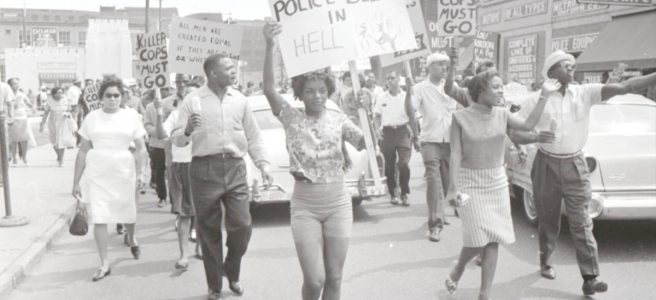
Dr. Anna E. Lindner discusses the rise and subsequent downfall of the West Central Organization in Detroit, a coalition of civil rights organizations, community groups, and church congregations that sought to bring attention to housing inequality and other social issues in the 1960s. Although founded with good intent, the group’s aggressive lobbying gained short-term results but turned local media and government administrations against them, and the predominantly white liberal leaders in the organization’s first early years struggled to fully understand and address the systemic racism faced by Black Detroiters.
Lindner is an assistant professor of Media & Communication at Nazareth University and author of the essay, “Seeking ‘Self-Determination’ in Detroit: Housing, Race, and the Activism of the West Central Organization, 1964-1971.”
Dr. Matt Kautz explores how evolving school disciplinary practices, changes in crime reporting, and political pressure in the decades following school desegregation led to the rise of student suspensions, expulsions, dropouts, and the school-to-prison pipeline in Detroit and other cities. Kautz is an Assistant Professor in the Department of Leadership and Counseling at Eastern Michigan University. His article “Schools and the Rise of Mass Incarceration in a Post-Brown World,” was published in the Summer 2024 issue of Harvard Educational Review.
Dr. Say Burgin explains that contrary to the common belief that white activists were purged from the Black freedom movement in the mid-1960 and 1970s, Black-led organizations in Detroit – including the Northern Student Movement, the City-Wide Citizens Action Committee, and the League of Revolutionary Workers—called on white activists to organize within their own white networks to support Black self-determination in education, policing, employment, and labor unions. Burgin is an assistant professor of history at Dickinson College and author of Organizing Your Own: The White Fight for Black Power in Detroit.
Dr. Matthew Lassiter shares stories uncovered in Detroit Under Fire: Police Violence, Crime Politics, and the Struggle for Racial Justice in the Civil Rights Era, a collaborative digital exhibit created by undergraduate history students documenting nearly 200 civilians killed between 1957 and 1973 by the Detroit Police Department and other law enforcement agencies in the city. Because identifying information was rarely included in official reports or the city’s mainstream media, the students instead searched the archives of local activists and community organizations to identify the victims and the circumstances of their deaths. In the process, they also found that “get-tough” policies, investigative arrests, and policing units like STRESS (Stop the Robberies–Enjoy Safe Streets) encouraged police brutality, and that nearly all of the officers involved were exonerated despite approximately two-thirds of the victims being unarmed. They found patterns of racial abuse, including that 79% of the victims were Black, and that the killings were clustered in downtown and midtown Detroit, commercial corridors, and other “color lines” where the predominantly white and predominantly Black areas of the city converged. Beyond these patterns of state violence, the website also documents the activism and resilience of the Black community.
Lassiter is Professor of History, Professor of Urban and Regional Planning, and the Arthur F. Thurnau Professor at the University of Michigan and director of the Policing and Social Justice HistoryLab, an initiative of the University of Michigan Department of History and the UM Carceral State Project.
Dr. Melissa Ford explores the influence of working-class Black women in Detroit, St. Louis, and Cleveland on the development of Black radicalism in the American Midwest during the Great Depression.
Ford is an associate professor of African American history at Slippery Rock University and author of A Brick and a Bible: Black Women’s Radical Activism in the Midwest during the Great Depression.
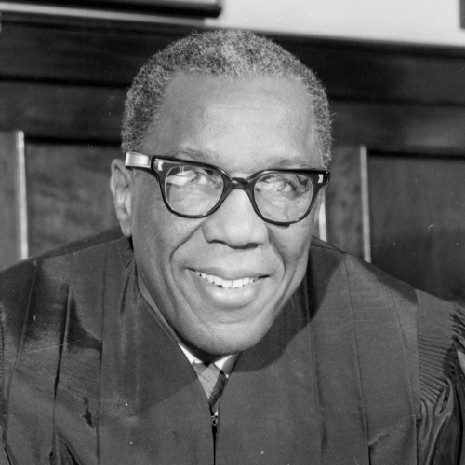
Peter Hammer describes the life and legacy of civil rights icon George W. Crockett, Jr. A Black lawyer who fought racism and defended constitutional rights in landmark cases in the 1940s through the 1960s, Crockett brought his ethos to the Detroit Recorder’s Court during his time on the bench from 1966 through 1978, and to his decade of service in the 1980s as a Congressman in the U.S. House of Representatives.
Hammer is an A. Alfred Taubman Endowed Chair in the Wayne State University Law School and director of the Damon J. Keith Center for Civil Rights. With Wayne State Law Professor Emeritus Edward J. Littlejohn, Hammer coauthored the biography, No Equal Justice: The Legacy of Civil Rights Icon George W. Crockett Jr.
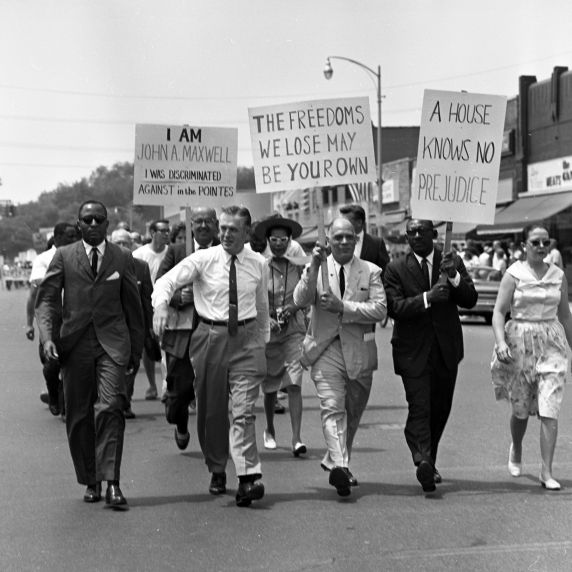
Emma Maniere describes how homeowners associations in Grosse Pointe, an affluent suburb bordering Detroit, developed a point system following the Second World War to rank and exclude prospective homebuyers to maintain the community’s Anglo Christian whiteness and affluence. The point system, which ranked nativity and ethnicity, accent, skin tone, and occupation, among other measures, was dismantled in 1960 but left a pernicious legacy that continues to reverberate in the community today. Maniere is a doctoral candidate in the history program at New York University.