Wildcat of the Streets: Detroit in the Age of Community Policing

Dr. Michael Stauch explains how newly elected Detroit Mayor Coleman Young introduced “community policing” to the city in 1974, an experimental approach to law and order that included affirmative action hiring policies and neighborhood police stations to address community concerns about both police brutality and criminal activity in the neighborhoods. Despite these changes, tensions with the police remained, leading Black youth in the city to embrace labor radicalism from the shopfloors as they built informal economies and decentralized gangs to challenge and achieve political and social power in the 1970s and 1980s. Stauch is an Associate Professor of History at the University of Toledo and author of Wildcat of the Streets: Detroit in the Age of Community Policing .

Related Resources:
Wildcat of the Streets: Detroit in the Age of Community Policing

Related Collections:
James and Grace Lee Boggs Papers (UP001342)
Kenneth V. and Sheila M. Cockrel Papers (UP001379)
Coleman Young Papers (UP000449)

Episode Credits
Interviewee: Michael Stauch
Producers: Dan Golodner and Troy Eller English
Music: Bart Bealmear

Detroit Under Fire: Police Violence and Racial Justice in the Civil Rights Era

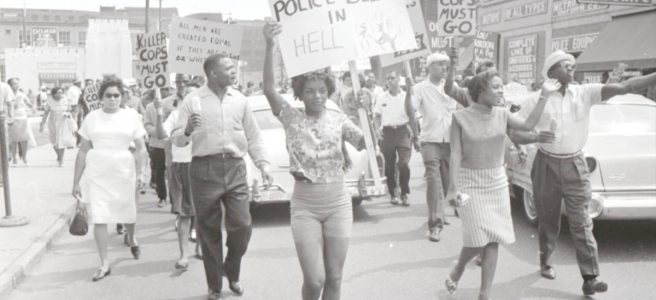
Crowd of people carrying picket signs (one reads, ""killer cops must go,"" another, ""All Gestapo police belong in Hell"") walk down street to protest the fatal shooting of an African American woman by Detroit Police in 1963.

Dr. Matthew Lassiter shares stories uncovered in Detroit Under Fire: Police Violence, Crime Politics, and the Struggle for Racial Justice in the Civil Rights Era, a collaborative digital exhibit created by undergraduate history students documenting nearly 200 civilians killed between 1957 and 1973 by the Detroit Police Department and other law enforcement agencies in the city. Because identifying information was rarely included in official reports or the city’s mainstream media, the students instead searched the archives of local activists and community organizations to identify the victims and the circumstances of their deaths. In the process, they also found that “get-tough” policies, investigative arrests, and policing units like STRESS (Stop the Robberies–Enjoy Safe Streets) encouraged police brutality, and that nearly all of the officers involved were exonerated despite approximately two-thirds of the victims being unarmed. They found patterns of racial abuse, including that 79% of the victims were Black, and that the killings were clustered in downtown and midtown Detroit, commercial corridors, and other “color lines” where the predominantly white and predominantly Black areas of the city converged. Beyond these patterns of state violence, the website also documents the activism and resilience of the Black community.

Lassiter is Professor of History, Professor of Urban and Regional Planning, and the Arthur F. Thurnau Professor at the University of Michigan and director of the Policing and Social Justice HistoryLab, an initiative of the University of Michigan Department of History and the UM Carceral State Project.

Related Resources:
Detroit Under Fire: Police Violence, Crime Politics, and the Struggle for Racial Justice in the Civil Rights Era

Related Collections:
Jerome P. Cavanagh Papers (UP000379)
Kenneth V. and Sheila M. Cockrel Papers (UP001379)
Coleman Young Papers (UP000449)
Detroit Commission on Community Relations (DCCR) / Human Rights Department Records (UR000267)
NAACP Detroit Branch Records (UR000244)

Episode Credits
Producers: Dan Golodner and Troy Eller English
Interviewee: Matthew Lassiter
Music: Bart Bealmear