Freedom Train: Black Politics and the Story of Interracial Labor Solidarity

Dr. Cedric De Leon explains how, from the founding of the African Blood Brotherhood in 1919 through the 1963 March on Washington, Black workers linked racial justice to economic justice, challenging the American labor movement to become more racially inclusive in its fight for workers’ rights.

De Leon is Professor of Sociology and Labor Studies at the University of Massachusetts Amherst and author of Freedom Train: Black Politics and the Story of Interracial Labor Solidarity.

Related Resources:
Freedom Train: Black Politics and the Story of Interracial Labor Solidarity

Related Collections:
Black Workers in the Labor Movement Oral Histories (LOH002210)
Coalition of Black Trade Unionists Records (LR001754)
CIO Office of the Secretary-Treasurer Records (LR000185)
Erma Henderson Papers (UP001624)
Harold Norris Papers (UP000508)
Robert “Buddy” Battle III and Marion Battle Papers (LP001801)
UAW President’s Office: Walter P. Reuther Records (LR000261)
UAW Washington Office Legislative Department: Donald Montgomery Records (LR000036)

Episode Credits
Interviewee: Cedric De Leon
Producers: Dan Golodner and Troy Eller English
Music: Bart Bealmear

Talking History with AFA President Sara Nelson

In celebration of the Reuther Library’s 50th anniversary, Sara Nelson, International President of the Association of Flight Attendants-CWA, AFL-CIO discusses the importance of understanding labor and legislative history when bargaining for better labor contracts for flight attendants today.

Related Resources:
Turbulent Romance: The History of the Association of Flight Attendants

Related Collections:
Association of Flight Attendants: Dallas Records (LR000981)
AFA Chicago/Rosemont: McDonald v. UAL Case Records (LR002386)
AFA Washington, D.C.: McDonald v. UAL Case Records (LR002385)
ALPA Steward and Stewardess Division Records (LR002252)
ALPA Dallas BNF MEC Records (LR003073)

Episode Credits
Interviewee: Sara Nelson
Producers: Dan Golodner and Troy Eller English
Music: Bart Bealmear

Union Exemption: Nonprofit Work and the Boundaries of the Commercial Economy, 1951–1976

John Miles Branch discusses the National Labor Relations Board’s policy to dismiss union petitions at charitable organizations in the decades following the Second World War, and the policy’s reversal in 1976 when the board acknowledged nonprofit institutions as a “third sector” of the economy linked with the nation’s commercial life.
Branch is a Ph.D. candidate in U.S. History at Northwestern University and author of the article, “Union Exemption: Nonprofit Work and the Boundaries of the Commercial Economy, 1951–1976.”

Related Resources:
“Union Exemption: Nonprofit Work and the Boundaries of the Commercial Economy, 1951–1976”

Related Collections:
Milton Tambor Papers (LP002342)
Thelma Bernstein Papers (LP000683)

Episode Credits
Interviewee: John Miles Branch
Producers: Dan Golodner and Troy Eller English
Music: Bart Bealmear

Para Power: How Paraprofessional Labor Changed Education

Dr. Nick Juravich discusses the experiences of the first-generation of paraprofessional educators in New York City in the 1960s-1980s and their impact on the city’s educational system, community relations, and public sector unions. Juravich is an Assistant Professor of History at the University of Massachusetts Boston and author of Para Power: How Paraprofessional Labor Changed Education.

Related Resources:
Para Power: How Paraprofessional Labor Changed Education

Related Collections:
AFT President’s Office: Albert Shanker Records
AFT Massachusetts Federation of Teachers Records (LR001071)
Kansas City Federation of Teachers, Local 691 Records (LR000624)
United Educators of San Francisco Local 61 Records (LR000524)

Episode Credits
Interviewee: Nick Juravich
Producers: Dan Golodner and Troy Eller English
Music: Bart Bealmear

The Worthy Wages Movement for Childcare Workers

Dr. Justine Modica discusses the Worthy Wages movement centered in Seattle from the 1980s through the 2000s. Affiliated with SEIU, daycare directors and childcare workers in childcare centers and home-based daycares joined together to raise public awareness of the underfunding of daycare and lobby for increased state childcare subsidies, hoping to increase the wages and retention of skilled workers in a lowly-paid but critical field.

Modica is a Klarman Postdoctoral Fellow in History at Cornell University. She authored the article, “Worthy Wages in the Emerald City: Worker- and Director-Led Childcare Movements in Seattle, 1984–2006,” and is writing a book examining how the government, employers, and families have shaped childcare as wage labor.

Related Resources:
“Worthy Wages in the Emerald City: Worker- and Director-Led Childcare Movements in Seattle, 1984–2006”

Related Collections:
Center for the Child Care Workforce Records

Episode Credits
Interviewee: Justine Modica
Producers: Dan Golodner and Troy Eller English
Music: Bart Bealmear

The UAW’s Southern Gamble in Foreign-Owned Factories

Dr. Stephen Silvia explains how the UAW built a cooperative relationship with workers’ councils and unions at foreign automotive companies, but has nevertheless struggled to organize those companies’ vehicle factories in the southern United States since the 1990s due to anti-labor politics and the companies’ shared anti-union playbooks. Silvia is a professor in the School of International Service at American University and author of The UAW’s Southern Gamble: Organizing Workers at Foreign-Owned Vehicle Plants.

Related Resources:
The UAW’s Southern Gamble: Organizing Workers at Foreign-Owned Vehicle Plants

Related Collections:
UAW President’s Office: Douglas Fraser Records (LR001116)
UAW Vice-President’s Office: Donald Ephlin Records (LR001404)
UAW President’s Office: Howard Young Records (LR001400)
UAW President’s Office: Owen Bieber Records (LR001270)
UAW President’s Office: Stephen P. Yokich Records (LR001626)

Episode Credits
Producers: Dan Golodner and Troy Eller English
Interviewee: Stephen J. Silvia
Music: Bart Bealmear

“Girls, We Cannot Lose!”: Midwestern Black Women Activists During the Great Depression

Dr. Melissa Ford explores the influence of working-class Black women in Detroit, St. Louis, and Cleveland on the development of Black radicalism in the American Midwest during the Great Depression.

Ford is an associate professor of African American history at Slippery Rock University and author of A Brick and a Bible: Black Women’s Radical Activism in the Midwest during the Great Depression.

Related Collections:
Black Workers in the Labor Movement Oral Histories
Black Workers in the Labor Movement Oral Histories: Joseph and Rose Billups
Robert W. Dunn Papers
Maurice Sugar Papers

Related Resources:
A Brick and a Bible: Black Women’s Radical Activism in the Midwest during the Great Depression.
Subject Focus: Ford Hunger March
1932 Ford Hunger March Image Gallery

Episode Credits
Producers: Dan Golodner and Troy Eller English
Interviewee: Melissa Ford
Music: Bart Bealmear

Bargaining for the Common Good: Milton Tambor Reflects on 50 Years in Labor and Social Activism

Labor leader and social activist Milton Tambor discusses his life’s work in Detroit since the 1950s as a social worker; AFSCME local union president, staff representative and assistant education director; and teaching faculty in both labor studies and social work at Wayne State University and other institutions. He also discusses the intersection of labor and social political movements through his involvement in organizations such as the Detroit Coalition to End the War Now, the Michigan Labor Committee on Central America, and the Democratic Socialists of America in both Detroit and Atlanta. Tambor recently published a memoir titled A Democratic Socialist’s Fifty Year Adventure.

Related Collections:
AFSCME Michigan Council 25 Records
Detroit Coalition to End the War Now! Records
Milton Tambor Papers

Related Resources:
A Democratic Socialist’s Fifty Year Adventure

Episode Credits
Producers: Dan Golodner and Troy Eller English
Interviewee: Milton Tambor
Music: Bart Bealmear

Midnight in Vehicle City: Modern Lessons From the Flint Sit-Down Strike

Edward McClelland recounts the gripping details of the Flint sit-down strike, and considers what we can learn today from the strikers’ successful fight for shared prosperity in 1936-1937. McClelland is a journalist, historian, and author of Midnight in Vehicle City: General Motors, Flint, and the Strike That Built the Middle Class.

Related Collections:
Flint Labor Records
Genora and Sol Dollinger Papers
Henry Kraus Papers
Hy Fish Papers
Joe Walton Papers
Roy Reuther Oral History
Victor G. Reuther Papers
Wyndham Mortimer Papers

Related Resources:
Midnight in Vehicle City: General Motors, Flint, and the Strike That Built the Middle Class

Episode Credits
Producers: Dan Golodner and Troy Eller English
Interviewer: Dan Golodner
Interviewee: Edward McClelland
Music: Bart Bealmear

Jane Street and the Rebel Maids of Denver

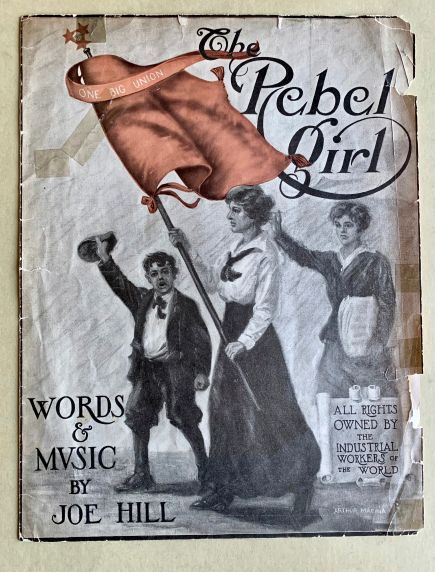
Cover Art, Sheet Music, "The Rebel Girl"

Historian Jane Little Botkin explains how Jane Street, a single mother, firebrand, and little-known IWW organizer, orchestrated a 1916 housemaids’ rebellion in Denver. To fight for better pay and working conditions in the elite Capitol Hill neighborhood, Street worked with—and later, despite—the IWW to blacklist and shame the area’s worst domestic employers, thereby disrupting the comfort and reputations of some of Denver’s most influential and powerful families.

Author of The Girl Who Dared to Defy: Jane Street and the Rebel Maids of Denver and Frank Little and the IWW: The Blood That Stained an American Family, Botkin has received two Spur Awards from the Western Writers of America, the Caroline Bancroft History Prize from the Denver Public Library Western History and Genealogy Department, and the Best Historical Nonfiction Award from the Texas Association of Authors.

Related Collections:
Industrial Workers of the World Records

Related Resources:
Botkin, J.L. (2021). The Girl Who Dared to Defy: Jane Street and the Rebel Maids of Denver. University of Oklahoma Press.

Episode Credits
Producers: Dan Golodner and Troy Eller English
Interviewer: Dan Golodner
Interviewee: Jane Little Botkin
Music: Bart Bealmear